RV Rental Near Maxwell Wildlife Refuge in Hesston, KS
Every spring I get the same call from families who just found out the bison herd at Maxwell Wildlife Refuge is running near the road — they want to be out there at dawn, not driving forty-five minutes from a Wichita hotel. That’s the whole reason a Maxwell Wildlife Refuge RV rental makes so much sense: you wake up already on the refuge grounds, coffee in hand, and you’re watching a 200-pound calf chase its mother across the tallgrass before the day-trippers have even turned off I-135 at Exit 34 in McPherson County. I deliver and set up rigs at Maxwell’s campground regularly, and I want to walk you through exactly how this works — the sites, the timing, the drive, and what to expect when you get there.
What Maxwell Wildlife Refuge Actually Looks Like on the Ground
Maxwell Wildlife Refuge sits just north of Canton, Kansas, in McPherson County — about 18 miles northeast of McPherson and roughly 35 miles north of Hesston on K-15. The refuge covers around 2,800 acres of native Kansas tallgrass and mixed-grass prairie, and it holds one of the only free-roaming bison herds in the state that visitors can actually access by vehicle or on foot through the tour route. There’s also an elk herd that shares the property, which surprises people who assume elk are a Rocky Mountain thing. When I pull into the main entrance on a delivery, the landscape flattens out and opens up in every direction — you’re looking at genuine South Central Kansas prairie, not a manicured park, and that rawness is exactly the point.
The Kansas Department of Wildlife and Parks manages the property. The campground is a straightforward, no-frills setup — this is not a resort-style park with a pool and a camp store, and I want to be honest about that upfront. If you’re expecting Cheney State Park amenities, this isn’t that. But if you want to fall asleep hearing coyotes on the Kansas prairie and wake up 200 yards from a bison pasture, Maxwell is genuinely hard to beat anywhere in the state.
Delivering Your RV to Maxwell’s Campground: What I Do to Prep
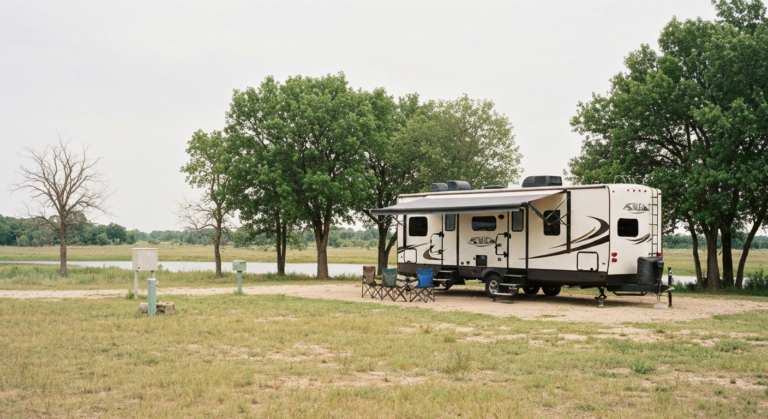
When I deliver a rig to Maxwell Wildlife Refuge campground, the approach road is straightforward enough — you’re coming in off the main refuge road, and I haven’t run into the kind of sharp low-clearance entrance issues I sometimes deal with at tighter county parks. That said, the campground sites themselves are not long pull-throughs built for 40-foot fifth wheels. I match customers to a mid-size travel trailer or a smaller motorhome for this location — something in the range that fits comfortably in a standard back-in site without needing three-point maneuvering in the dark after a long drive. When I call customers before delivery, I always flag this: if you’re a family of five and you think you need every square foot, let’s talk through the site dimensions first before we match you to a rig.
My delivery route from Hesston typically runs north on US-81 to K-15, then northeast into McPherson County — it’s about 40 minutes door to site on a clear day. I set the rig level, hook up what’s available on-site, walk the customer through the slideouts and systems, and make sure everything is functioning before I leave. I’m available by phone at 620-951-4948 throughout your stay for any questions that come up — that’s not a call center, that’s me or my team who actually knows which site I put you on.
One honest note on hookups: site utility configurations at smaller refuge campgrounds can change seasonally or by site number. I verify current hookup availability before every delivery and will tell you plainly what’s offered. If you have specific power or water needs, reach out to us at [email protected] before booking so we can match you to the right unit and confirm what the site provides. Don’t assume full hookups — let me confirm it for your specific dates.
The Best Time of Year to Camp at Maxwell Wildlife Refuge
South Central Kansas has a season for everything out here, and Maxwell is genuinely different month to month. Here’s what I tell renters depending on when they’re planning to come:
- Late March through May: This is my busiest delivery window for Maxwell. The tallgrass is greening up fast, the bison calves start dropping in April, and the weather in McPherson County is warm enough to sit outside in the evening without a coat — usually. Kansas spring means you can get a 75-degree afternoon followed by a 45-degree overnight, so I always tell renters to pack layers and make sure they know how to run the furnace. Winds can be stiff out of the south, which is normal for the Plains, and the prairie wildflowers are worth the trip on their own.
- June and July: Hot. Genuinely hot — I’m talking high 90s and real humidity some weeks. The refuge is still beautiful and the bison don’t mind the heat, but you’ll want a rig with a functioning air conditioner and you’ll want to do your outdoor walking in the early morning. I don’t discourage summer trips, but go in eyes open. Sunset tours along the refuge road in late July are stunning when the light goes golden across the grass.
- September and October: Hands down the best camping weather of the year out here. Highs in the 70s, cool nights, and the elk rut starts in September — if you’ve never heard bull elk bugling at 5 a.m. on the Kansas prairie, it’s an experience that genuinely stops you cold. I get calls every fall from people who didn’t realize they’d need to book a few weeks out for October weekends. Book early for fall.
- November through February: I do deliver to Maxwell in the off-season for hunters and hardcore wildlife watchers, but the campground has limited or no services in the coldest months. If you’re planning a winter trip, call me directly — 620-951-4948 — before you book anything, and I’ll tell you honestly what’s open and what unit makes sense for Kansas winter temperatures.
What to Do While You’re Based at Maxwell
The refuge itself will fill more time than most people expect. The self-guided auto tour covers the bison and elk pastures, and depending on the time of year and where the herd is grazing, you might spend an hour slowly rolling through and watching animals 30 feet from your window. There are hiking trails as well — nothing technically demanding, but the Prairie nature trail gives you a real on-foot sense of what unbroken Kansas tallgrass feels like, which is something that you have to experience to understand. There’s a reason Kansas was called the Sea of Grass.
McPherson is about 20 minutes southwest on K-61 and has solid grocery options for restocking the rig — I always recommend customers do a full grocery run before heading out to the refuge since Canton itself is a small town. Newton is about 30 miles south and gives you access to the Warkentin House if you’re into Kansas history. If you want to make a full regional trip, the Kansas Cosmosphere and Space Center in Hutchinson is about 45 minutes southwest of Maxwell on US-56 — it’s a genuine world-class science museum and worth an afternoon away from camp. Strataca, the Kansas Underground Salt Museum, is in the same city and pairs well for a day trip. Sand Hills State Park near Hutchinson is another campground option if you’re extending your trip across multiple parks and want a change of scenery — I deliver there regularly as well.
For families with kids, the bison viewing is the main event and it’s completely free once you’re on the refuge. I’ve had grandparents tell me it was the best trip they’d taken with their grandchildren in years — not because it was elaborate, but because it was real. That’s the Kansas prairie doing what it does.
Getting to Maxwell Wildlife Refuge: Routes and Drive Times
Maxwell Wildlife Refuge is located just north of Canton, Kansas, which puts it in a genuinely convenient position for travelers coming from several directions across South Central Kansas. From Hesston, the most direct route runs north on US-81 through Newton, then picks up K-15 northeast toward Canton — figure about 40 minutes. From Wichita, you’re looking at roughly an hour, heading north on I-135 and then jogging northeast through McPherson County. From McPherson, it’s a quick 20 minutes northeast. From Hutchinson, take US-50 east to K-61 north, and you’re there in about 45 minutes.
Newton City-County Airport (EWK) is the closest general aviation field if you’re flying in from out of state and renting locally. Wichita Dwight D. Eisenhower National Airport (ICT) is the major commercial hub — I’ve had customers fly into Wichita, pick up a vehicle, and meet me at the refuge on a Friday afternoon. That works fine and I can time delivery to your arrival. If that’s your plan, just let me know when you book.
How to Book a Maxwell Wildlife Refuge RV Rental with Fireside
Booking with us is straightforward. I’m a local owner — I know the refuge, I know the campground, and I’m not going to put you in a rig that doesn’t fit the site or the group. Here’s how the process works:
First, reach out. Call me at 620-951-4948 or email [email protected] and tell me your dates, how many people are in your group, and any specific needs — pets, mobility considerations, whether you have young kids who need sleeping space accounted for carefully. I’ll ask you about hookup expectations and confirm what Maxwell’s campground is offering on those dates. Then I’ll recommend the right unit from our fleet for the site and your group size.
I handle delivery and setup, so you don’t need to tow anything or know how to back a trailer into a site. I walk you through the rig before I leave, I’m available by phone during your stay, and I pick it up at checkout. If something isn’t working right — a slideout being stubborn, a question about the water system — you call me directly, not a national 1-800 number. That’s the difference between renting from a local operator who delivers to this specific campground regularly and booking through a platform that’s never seen the refuge entrance.
Peak weekends in May and October book out faster than people expect — I’ve had customers call on a Thursday trying to get a rig for Saturday at Maxwell during elk rut season, and I’ve had to turn them away. If you have specific dates in mind, contact us early. A few weeks out is good; a month out for fall weekends is better.
Ready to plan your trip? Browse the fleet to see what we have available for the South Central Kansas area, and check our full guide to campgrounds and RV parks across Harvey, McPherson, Reno, and the surrounding counties — whether Maxwell is your main stop or one park in a longer loop across the Kansas plains, we’ll get you set up right.